
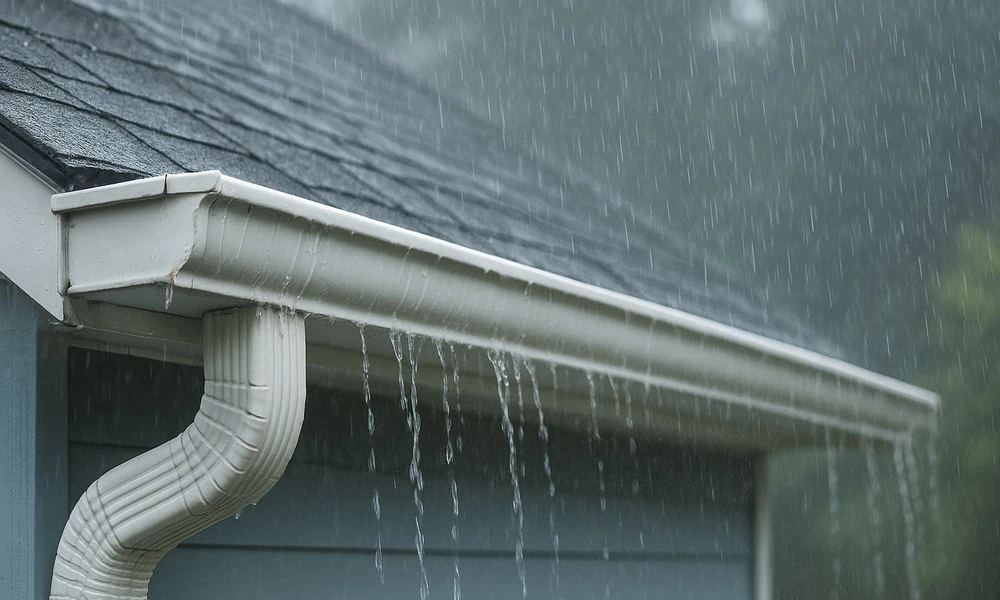

An inch of rain falling on a 2,000 square foot roof comes to about 1,250 gallons of water. In southwest Oklahoma that inch can arrive in under an hour. During a spring squall line it can come in a quarter of that. Every gallon slides toward the eaves looking for the easiest way down, and the gutter system decides where it ends up.
Homeowners near Fort Sill and the Wichita Mountains often don’t think about that system until something sags, overflows or pulls loose. A roofing and exterior contractor working from US-277, Liberty Roofing installs new gutters, replaces worn runs and resecures sagging sections. It is veteran-owned and answers calls around the clock. For anyone looking into Elgin gutter installation, the useful thing to know is that a gutter works as a chain of parts. The chain is only as strong as its weakest link, so the rest of this piece follows the water down it.
The Handoff at the Roof Edge
The first job happens before water ever touches the trough. Shingles overhang the eave slightly, and a metal drip edge carries water past the fascia board. The back flange of the gutter should sit tucked behind that drip edge, never in front of it. If the gutter hangs too low or too far out, water sheets down the gap and soaks the fascia. That is how rot starts in boards that look fine from the yard.
That is also why a good installer looks hard at the fascia before hanging anything new. Soft wood, peeling paint or dark streaks behind an old gutter mean the boards need repair first. New aluminum screwed into rotten wood will pull loose within a season or two, usually during the heaviest storm of the year.
How Big the Channel Needs to Be
Most homes get five inch K-style gutters by default, and on plenty of houses that’s enough. Southwest Oklahoma storms change that. Intense bursts of rain, steep roof pitches and long uninterrupted slopes all push more water into the trough than a five inch channel can carry. Six inch gutters hold roughly forty percent more, and they’re often the better choice in this climate. A careful sizing considers:
- The square footage of roof draining to each run, not the size of the whole house
- Roof pitch, since steeper slopes send water faster and can shoot it over the gutter lip
- Valleys, where two roof planes meet and dump a concentrated stream into one spot
- How hard local storms tend to hit, which matters more than the annual rainfall total
Valleys deserve special attention. Water racing down a valley can overshoot even a large gutter. A small splash guard riveted at the corner catches that stream and keeps it from cutting a trench in the flowerbed below.
Metal That Can Take a Beating
Material choice in Elgin comes down to heat, hail and wind more than appearance.
Seamless aluminum is the workhorse for good reason. It is formed on site from a coil to the exact length of each wall, which removes the joints where most leaks start. A thicker gauge, around .032 inch instead of the thinner .027, holds up better against hail dents and the weight of a ladder leaning against it.
Galvanized steel shrugs off impacts that would crease aluminum, though it is heavier and will eventually rust where the coating gets scratched.
Vinyl costs less up front but struggles here. Summer days near 100 degrees followed by freezing winter nights make it expand and contract until the joints work loose and the plastic turns brittle.
Copper lasts for generations and looks striking on brick homes, and it is priced accordingly.
Slope You Can Barely See
A gutter that looks perfectly level is actually a problem. Water needs a gentle fall toward the outlet, usually about a quarter inch for every ten feet of run. Too little slope leaves standing water that breeds mosquitoes and adds weight. Too much makes the gutter look visibly crooked against the roofline. On runs longer than about forty feet, installers often pitch the gutter from the middle down to an outlet at each end, so neither half has to carry the whole load.
The hangers hold that slope in place. Older homes often still have spikes driven through ferrules, and those tend to work loose as the wood swells and shrinks. Hidden hangers screwed into the fascia every two feet or so hold much better. Spacing them closer under heavy tree cover or in ice storm country makes sense, since a gutter full of frozen debris can weigh hundreds of pounds. Anyone who remembers the ice storms that have hit the Lawton area knows how fast weak gutters come down.
The Vertical Drop
Downspouts are where many systems quietly fail. The common 2 by 3 inch size handles a modest roof area, while 3 by 4 inch downspouts carry about twice as much water and clog far less often with leaves and shingle grit. Adding an extra downspout on a long run is one of the cheapest upgrades available, and it eases pressure on the whole system.
Where downspouts sit matters too. Putting them near inside corners, away from walkways and driveways, keeps winter runoff from refreezing where people walk. Each elbow slows the flow and gives debris another place to snag, so a straight drop is always better than a twisting route.
Where the Water Finally Lands
Everything above can be done perfectly and still let a house down if the downspout dumps water at the foundation. Much of Comanche County sits on clay soils that swell when soaked and shrink as they dry. Repeated saturation along one side of a house can lead to cracked slabs, sticking doors and gaps opening around window frames.
Oklahoma State University Extension has a practical guide to disconnecting and extending residential downspouts that walks through adding extensions and splash blocks so runoff spreads across the lawn instead of eroding soil or pooling against the house. Carrying discharge at least four to six feet out is the usual target. Some homeowners go further with rain barrels for garden watering, or with buried lines that empty toward the street or a rain garden in the lowest part of the yard.
Living With It After Install
Gutter guards help under oak and elm canopies but don’t eliminate maintenance. Fine pollen and shingle granules still build up on top of mesh screens, and they need occasional brushing. A spring check before storm season and a fall cleanout after the leaves drop will catch most problems early. After any hailstorm, it is worth walking the perimeter and looking for dented runs, loosened hangers or downspouts knocked out of their brackets, because hail damage to gutters is often covered in the same claim as the roof.
A well-installed gutter rarely gets noticed, and that’s a good sign that the water is ending up away from the house.